

Cognitive & Sleep Support, DSIP, Peptides
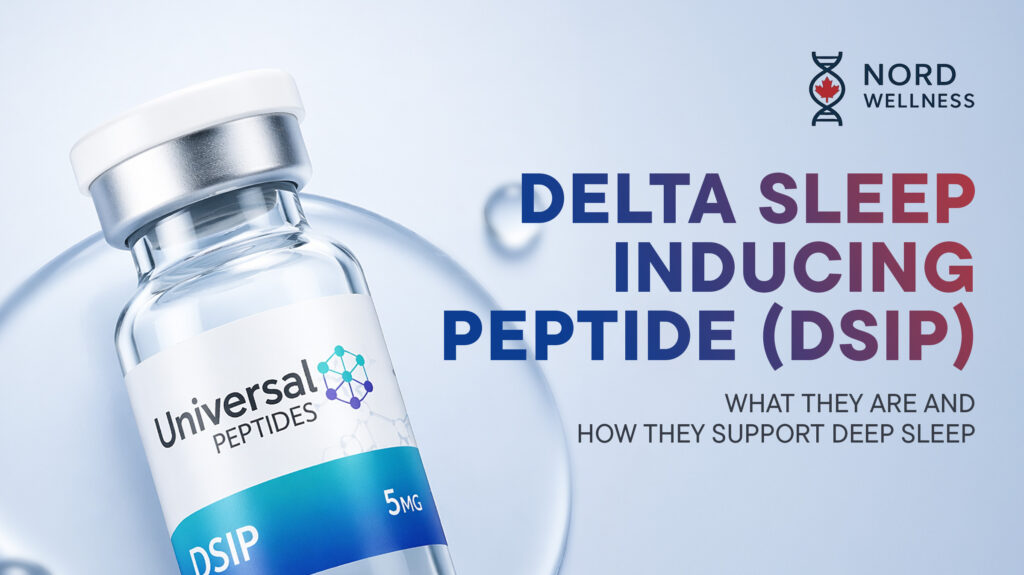
Delta Sleep Inducing Peptide (DSIP): What They Are and How They Support Deep Sleep Naturally
Apr
Deep sleep is one of the most important stages of the sleep cycle, playing a critical role in physical recovery, hormonal regulation, cognitive restoration, and overall neurological health. However, modern stress, irregular schedules, and disrupted circadian rhythms can interfere with the body’s ability to maintain healthy sleep architecture.
In peptide research, scientists have become increasingly interested in compounds that may support the body’s natural sleep processes rather than simply inducing sedation. One of the most studied neuropeptides in this area is Delta Sleep Inducing Peptide (DSIP).
Known for its association with slow-wave sleep and neuroendocrine regulation, DSIP continues to attract attention in research focused on sleep quality, stress adaptation, and recovery. Explore more science-backed wellness insights and peptide research advancements at Nord Wellness
What Are Delta Sleep Inducing Peptide (DSIP)?
Delta Sleep Inducing Peptide (DSIP) is a naturally occurring neuropeptide made up of nine amino acids. It was originally identified during sleep research studies and later became associated with deep sleep regulation.
DSIP is considered an endogenous peptide, meaning it can naturally occur within the body. Researchers have detected DSIP in both the central nervous system and peripheral tissues, suggesting it may play a broader regulatory role beyond sleep alone.
Unlike many traditional sleep-related compounds, DSIP is not primarily studied as a sedative. Instead, researchers believe it functions as a modulatory peptide that may help support the body’s natural sleep architecture and neurohormonal balance.
👉 Explore high-quality DSIP peptides for research purposes
History and Discovery of DSIP
DSIP was first discovered in the 1970s during experiments involving induced sleep states in animal models.
Researchers observed that extracts associated with delta-wave sleep appeared to contain a peptide capable of influencing sleep patterns. Researchers later isolated this peptide and named it Delta Sleep Inducing Peptide because of its connection with slow-wave sleep activity.
Over time, research expanded beyond sleep induction to investigate DSIP’s possible involvement in:
- Circadian rhythm regulation
- Stress adaptation
- Hormonal balance
- Neuroendocrine signaling
Although early findings generated strong interest, later studies produced mixed results, making DSIP a continuing subject of scientific investigation.
How Delta Sleep Peptide Affect Deep Sleep Cycles
Deep sleep, also known as slow-wave sleep (SWS), features delta brain wave activity and plays an essential role in recovery and restoration.
Research suggests DSIP may influence deep sleep by:
- Supporting slow-wave sleep duration
- Improving sleep cycle stability
- Reducing sleep fragmentation
- Helping regulate transitions between sleep stages
DSIP is believed to interact with systems involving:
- GABA signaling
- Serotonin pathways
- Hypothalamic sleep regulation
- Circadian rhythm control
Rather than directly causing sedation, DSIP may help optimize the body’s natural ability to enter and maintain restorative sleep states.
To learn more, explore our full article on DSIP Peptide: Benefits, Mechanism, and How Delta Sleep Peptide Works.
Key Benefits of Delta Sleep Inducing Peptide
Current research on DSIP has focused on several potential benefits:
1. Support for Deep Sleep
DSIP is primarily studied for its connection to slow-wave sleep and restorative sleep quality.
2. Stress Response Modulation
Research suggests DSIP may influence cortisol and stress-related hormone regulation.
3. Neuroendocrine Balance
DSIP may support communication between the nervous system and endocrine system.
4. Recovery and Fatigue Support
Because deep sleep is closely tied to tissue repair and recovery, DSIP has become a topic of interest in recovery-related research.
5. Circadian Rhythm Support
Some studies suggest DSIP may help stabilize sleep-wake cycle patterns.
It is important to note that these findings are primarily based on experimental and preclinical research.
DSIP vs Other Sleep Peptide
DSIP is often compared with other sleep-related compounds and neuropeptides.
| DSIP | Traditional Sleep Peptides or Aids |
|---|---|
| Supports natural sleep regulation | Often focuses on sedation |
| Associated with deep sleep quality | Primarily targets sleep onset |
| Investigated for neuroendocrine balance | Usually receptor-specific |
| Functions as a broad regulator | Often acts through direct receptor binding |
Unlike melatonin or sedative-based compounds, DSIP appears to function through more complex regulatory mechanisms involving multiple biological systems.
Potential Applications in Sleep and Recovery Research
Researchers continue exploring DSIP in several areas of scientific study:
- Sleep optimization and circadian rhythm research
- Stress-induced sleep disruption models
- Neurological recovery studies
- Physical recovery and fatigue research
- Neuroendocrine regulation
There is also growing interest in DSIP’s possible relationship with:
- Oxidative stress regulation
- Mitochondrial function
- Cellular adaptation to stress
While researchers continue to investigate these applications, they still view DSIP as a promising neuroregulatory peptide.
Safety and Research Considerations
Because DSIP is a peptide, several research considerations are important:
| Research Consideration | Description |
|---|---|
| Peptide Stability | DSIP can be sensitive to enzymatic degradation and improper storage conditions. |
| Delivery Methods | Research models commonly use intranasal or injectable delivery methods. |
| Variability in Findings | Results may vary depending on biological model, dosage, and administration protocols. |
| Regulatory Status | DSIP is generally classified as a research peptide and is not approved for the treatment or prevention of disease. |
| Ongoing Research | Further research is needed to better understand its long-term biological effects and mechanisms. |
FAQ – Delta Sleep Inducing Peptide
1. What is Delta Sleep Inducing Peptide (DSIP)?
DSIP is a naturally occurring neuropeptide studied for its potential role in deep sleep regulation, stress response, and neuroendocrine balance.
2. Does DSIP directly cause sleep?
DSIP is not considered a traditional sedative. Research suggests it may support natural sleep architecture rather than directly forcing sleep onset.
3. What makes DSIP different from melatonin?
Melatonin mainly regulates circadian timing, while DSIP is studied for broader effects on deep sleep quality, hormonal balance, and stress modulation.
4. How does DSIP support recovery?
By supporting deep sleep phases linked to tissue repair and hormonal release, DSIP may indirectly assist recovery processes.
5. Is DSIP approved for medical use?
DSIP is generally classified for research purposes and is not approved for medical treatment.
6. Why is DSIP important in sleep research?
Researchers are interested in DSIP because it may regulate multiple systems involved in sleep, stress adaptation, and recovery rather than acting through a single sedative pathway.
Conclusion
Delta Sleep Inducing Peptide (DSIP) remains one of the most intriguing neuropeptides in sleep and recovery research. Its potential role in supporting deep sleep, regulating stress responses, and maintaining neurohormonal balance continues to drive scientific interest.
Although much remains to be understood about its exact mechanisms, DSIP represents a unique approach to sleep optimization because it works through biological regulation rather than simple sedation.
Disclaimer
This content is provided by Nord Wellness for educational and research purposes only. DSIP is not approved for the diagnosis, treatment, cure, or prevention of any disease.



Really interesting article about DSIP and deep sleep research. I liked that the post explains how DSIP may support natural sleep architecture instead of simply acting like a sedative. The connection between recovery, hormones, and sleep quality was especially informative.
Good breakdown of how DSIP is being explored in sleep and recovery research. A lot of people underestimate how important deep sleep is for stress regulation and overall performance. Curious if future studies will better explain DSIP’s relationship with cortisol and circadian rhythms.
I appreciate how the article stays educational and research-focused instead of making exaggerated promises. The discussion about sleep quality, recovery, and neurohormonal balance made the topic much easier to understand. It definitely feels like research-based wellness topics are gaining more attention in Canada lately.