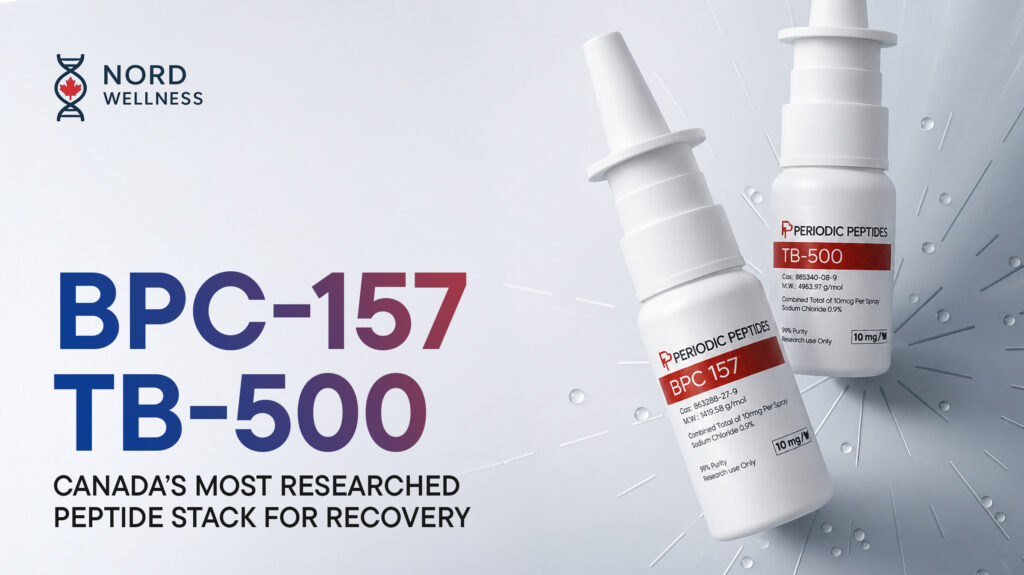
Whether you’re a sports scientist investigating tissue regeneration or a researcher exploring novel recovery compounds, two peptides consistently appear at the top of the literature: BPC-157 and TB-500. Together, they form one of the most studied peptide stack for recovery combinations in preclinical research — and Nord Wellness is proud to supply both at verified ≥98% purity, directly from our Canadian fulfillment center.
This guide breaks down the science behind this peptide stack for recovery. Additionally, it explains the rationale for combining them and why sourcing quality matters more than ever in 2025.
What Is BPC-157?
BPC-157 (Body Protection Compound-157) is a synthetic 15-amino-acid peptide originally derived from a gastric protein sequence. In particular, in preclinical models, it has been extensively studied for its potential role in:
Tendon and ligament repair — studies in rodent models demonstrate accelerated healing at Achilles tendon transection sites
Gastrointestinal protection — BPC-157 appears to support mucosal integrity and reduce intestinal inflammation markers
Neurological support — emerging animal data suggests neuroprotective properties via modulation of the brain-gut axis
Anti-inflammatory activity — interaction with the nitric oxide (NO) system and FAK-paxillin pathway may underlie its observed anti-inflammatory effects
For researchers looking to explore BPC-157 in depth, our product pageincludes full Certificates of Analysis (COA) from accredited third-party labs.
What Is TB-500?
TB-500 is a synthetic peptide corresponding to the 17–23 fragment of Thymosin Beta-4 (Tβ4), a naturally occurring protein found in virtually all mammalian cells. Similarly, its primary studied actions include:
Actin binding and cell motility — the LKKTETQ motif regulates cytoskeletal dynamics, enabling rapid cell migration to injury sites
Systemic recovery support — unlike BPC-157’s more localized action, TB-500 is believed to exert broader, systemic effects across musculoskeletal tissue
In contrast to BPC-157’s targeted, localized approach, TB-500 operates at a systemic level — making the two peptides highly complementary in research protocols.
Why Researchers Combine BPC-157 and TB-500 as a Peptide Stack for Recovery
The informal combination of BPC-157 and TB-500—sometimes called the “Wolverine Protocol” in research communities—has gained significant traction for one key reason: complementary mechanisms. As a result, researchers often explore this pairing to study synergistic effects on recovery.
Here’s how they work together in preclinical models:
Property
BPC-157
TB-500
Primary action
Localized tissue repair
Systemic cellular migration
Angiogenesis
Yes (via VEGFR2)
Yes (via actin dynamics)
Anti-inflammatory
Strong
Moderate
Gut protection
Yes
Limited
Nervous system
Yes
Limited
When used together in research settings, the two peptides appear to cover a broader spectrum of tissue repair pathways than either alone. As a result, researchers often study them as a combined approach to better understand their complementary effects.
Additionally, dual angiogenic stimulation through distinct mechanisms, combined with both local and systemic anti-inflammatory effects, therefore makes this stack a logical choice for researchers studying recovery, wound healing, and regenerative biology.
NordWellness supplies both individually and in our popular GLOW Bundle — a nasal spray kit combining BPC-157, TB-500, and GHK-CU for convenient research use.
The Importance of Purity in Peptide Stack for Recovery Research Peptides
Not all peptides are created equal. A significant challenge facing researchers today is the wide variation in product quality across suppliers. Contamination studies have identified heavy metals, bacterial endotoxins, and incorrect amino acid sequences in a substantial proportion of peptides sourced from unverified labs.
Third-party COA testing from accredited, independent laboratories
Proper cold-chain packaging designed to maintain compound stability during Canada-wide shipping
This commitment to quality isn’t just a marketing claim — it’s the foundation of reproducible research. Impure or mislabeled compounds compromise data integrity and, in clinical research contexts, pose serious ethical and safety concerns.
Browse our full peptide catalogue with downloadable COAs at Nord Wellness
Nasal Spray vs. Injectable: Delivery Formats for Research
One area of growing interest in peptide research is delivery methodology. While traditional protocols have used subcutaneous injection to achieve localized or systemic effects, however, nasal spray formulations have also emerged as a viable alternative delivery format worthy of study.
Additionally, Nord Wellness offers both injectable and nasal spray formats, allowing researchers to design comparative studies across different delivery routes. Our GLOW Nasal Spray Kit (BPC-157 + TB-500 + GHK-CU) is particularly popular among researchers investigating transmucosal absorption and systemic bioavailability.
Who Uses Research-Grade Peptides?
Nord Wellness serves a broad research community across Canada, including:
Academic and clinical researchers studying tissue regeneration and wound healing
Sports science institutions investigating recovery compounds for athlete populations
Biotechnology firms requiring consistent, documented peptide compounds for experimental protocols
Nord Wellness sells all products strictly for research and laboratory use. The company does not intend them for human or veterinary administration and has not received Health Canada approval as therapeutic drugs.Researchers are responsible for complying with all applicable regulations.
Ordering Research Peptides in Canada
One of the most common questions we receive: “Can I buy BPC-157 in Canada?”
Yes — NordWellness ships research-grade peptides across Canada from our domestic fulfillment center, with standard delivery in 2–5 business days. No customs delays. No minimum order. And for institutions and bulk research programs, we offer custom synthesis and wholesale pricing — contact us directly to discuss your requirements.
We accept major credit cards and Interac e-Transfer (Canadian customers), and all transactions are processed through encrypted, secure payment gateways.
Final Thoughts on the Peptide Stack for Recovery
BPC-157 and TB-500 remain two of the most actively researched peptides in the fields of regenerative medicine and recovery science. For researchers seeking reliable, high-purity compounds with transparent documentation, Nord Wellness is Canada’s trusted source.
Explore our full range of research peptides, nasal spray kits, and bundle offerings — all backed by third-party purity testing and fast Canadian shipping.
This content is provided by Nord Wellness for educational and research purposes only. Melanotan II is not approved for the diagnosis, treatment, cure, or prevention of any disease.
admin
3 thoughts on “BPC-157 and TB-500: Canada’s Most Researched Peptide Stack for Recovery”
Jason Carter says:
Great article—really like how it explains why BPC-157 and TB-500 are often combined. The idea of one supporting localized tissue repair while the other works systemically makes the stack much more logical from a recovery standpoint.
I appreciate how the article breaks down the complementary mechanisms. From my perspective, combining angiogenesis, anti-inflammatory signaling, and cell migration pathways shows why this stack is widely discussed in recovery research.
Very informative read. I see this stack as a multi-pathway approach to recovery, but it’s also clear that most of the evidence is still preclinical, which makes understanding limitations just as important as understanding the mechanisms.
New Year, New You! Ready to kickstart your wellness journey? Join our newsletter for exclusive tips, fitness inspiration, and special offers—let’s make this your best year yet!




Great article—really like how it explains why BPC-157 and TB-500 are often combined. The idea of one supporting localized tissue repair while the other works systemically makes the stack much more logical from a recovery standpoint.
I appreciate how the article breaks down the complementary mechanisms. From my perspective, combining angiogenesis, anti-inflammatory signaling, and cell migration pathways shows why this stack is widely discussed in recovery research.
Very informative read. I see this stack as a multi-pathway approach to recovery, but it’s also clear that most of the evidence is still preclinical, which makes understanding limitations just as important as understanding the mechanisms.